


Key Highlights:
- A recent study from the SEO industry states that 68% of all online experiences start with a search query.
- Above 50% of Google searches are in a zero-click format. This comes from multiple industry analyses
- AI is altering search results and zero-click behaviour. AI overviews and generative search summaries are now easily accessible in search queries, dropping the number of clicks
- Nearly 60% of Google queries are completed without a click
Introduction:
If your website traffic has dropped, stopped or seems to be inconsistent, you’re not alone. You may have invested in SEO services, search engine marketing and digital marketing, but the results don’t seem to be as expected. That’s because the way people search has fundamentally changed. At present, users don’t just search, they ask questions, expect quick replies, and are heavily dependent on voice assistants and AI-generated answers.
On average, about 68% of all online experiences still start with a search query indicating why search optimization remains important. But here’s the catch: more than half of Google searches are completed without a click, which allows users to find their answers directly on the results page without ever visiting a website.
This revolution has given rise to Answer Engine optimization (AEO) and Generative Engine Optimisation (GEO), two new search visibility strategies that go beyond the standard search engine optimization (SEO).
With Voice and AI features dominating how questions are being answered, always delivering responses before the links are even clicked. A successful search visibility now requires mastering all three SEO, AEO & GEO.
In this article, we’ll go over what they are, how they’re different, how to optimize them and why adopting them into your digital marketing and SEO strategy is more critical than ever.
Understanding SEO, AEO and GEO
SEO is the process of optimizing your website to appear higher on search engine results pages (SERPs) of top search engines like Google and Bing.
It Consists:
- On- Page SEO (Keywords, meta description, internal linking)
- Technical SEO (site speed, mobile compatibility)
- Content optimization
- Backlinks and Authority Building
For example, A blog optimized for the keyword “Best Marketing agencies in India” that ranks on the first page of Google is a result of excellent SEO marketing and optimization
AEO emphasizes on optimizing content to appear for direct and quick responses in featured snippets, voice search and AI assistants like Google Assistant, Alexa and Siri.Instead of just ranking, AEO tries to respond to user queries promptly.
For instance, when someone asks, “What is On-page SEO? And your content appears, that’s an example of answer engine optimization at work.
GEO is generative engine optimization it’s about optimizing content such that AI-powered generative engines like ChatGPT, Gemini, and Perplexity use it as a reliable source when generating responses
It mainly focuses:
- Contextual depth
- Structured Information
- Authority and credibility
In this regard, if an AI tool suggests your brand while discussing “search engine marketing strategies”, this shows your content is GEO-optimized.
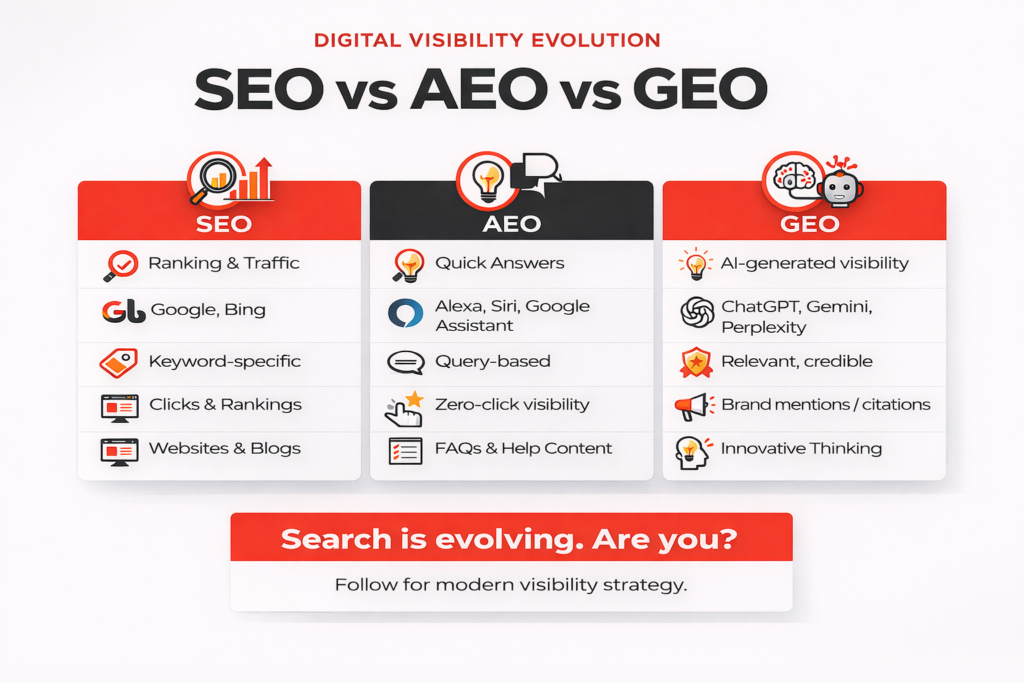
Optimization Content for SEO, AEO and GEO
SEO Best Techniques
- Use relevant SEO keywords naturally
- Optimize meta titles, descriptions and headers
- Enhance website speed and mobile UX
- Add Internal links across your SEO website
- Focus on excellent backlinks and reliable sources.
AEO Strategies:
- Write precise and short answers
- Make use of the FAQ style and structured data
- Address conversational queries
- Optimize for Voice search
- Focus on the user intent rather than keywords
GEO Tips
- Create deep and authoritative content
- Include Numbers, examples and expert insights
- Maintain consistent branding across all platforms
- Publish content that AI tools can easily refer to.
- Create topical authority across digital marketing and SEO
Content Formats That Work Best for SEO, AEO and GEO
Various content formats serve various search experiences. To maximise exposure visibility in search engines, answer engines and AI platforms, go for formats that are organised and intent-driven.
- Authority- Building Content:
Long-form blogs, comparative articles and case studies increase the subject authority, promote credibility and perform well for both SEO and GEO by assisting search engines and AI tools to recognise the context and relevance.
- Answer-Focused & Intent Driven Content:
FAQs and How-to guides provide clear, concise and direct answers, making them perfect for AEO, which boosts visibility in featured snippets and voice search results.
- Structured & Searchable Formats
Listicles, explainer content, videos with transcript and structured content blocks increase clarity and accessibility, allowing search engines and AI systems to read better and refer to information, assisting both SEO and GEO
Combining these formats enables consistent visibility in conventional search, voice search and AI- generated results.
Why websites lose traffic:Despite ongoing search engine optimization efforts, several websites experience a decline in traffic. This frequently occurs when search engines and algorithms change more quickly than conventional SEO techniques.
Common explanations include:
- Overly dependent on outdated SEO strategies that no longer fit with how search engines rank content
- Ignoring user intent and on-site experience
- Limited AEO- ready content that provides quick and direct answers
- No optimization for generative engines and AI-driven search
- Less redundant or low-value content
- Updates on search engine algorithms have an influence on rankings
- Poor Technical SEO, including website performance and mobile issues
To safeguard visibility and sustain long-term traffic development, major SEO firms use an integrated approach that consists of SEO, AEO and GEO
The Future of Search Visibility
Search has quickly changed above conventional rankings. In present times, search
has been shaped by zero-click results, AI- generated responses, voice-based questions and context-driven experiences that prioritise intent over keywords.
As this change increases, future-ready brands are adjusting their strategies. They are investing in generative engine optimization, developing strong omnichannel digital marketing platforms and prioritising content authority rather than keyword density. Winning visibility now necessitates a coordinated approach among performance marketing, content marketing, social media marketing, web development and other digital touchpoints.
The aim now is no longer to drive traffic but to be visible, trusted and discoverable wherever users search.
Conclusion
SEO is not dead, it’s changing at a fast pace. Brands that embrace SEO, AEO and GEO will dominate search across all digital platforms, devices and AI tools
FAQs
1.What is the difference between SEO and AEO?
SEO aims at ranking web pages, while AEO provides direct and quick responses in search results and voice assistants.
2. Is GEO replacing SEO?
No. GEO enhances SEO by optimizing content for AI- generated search experiences.
3. Do I need SEO, AEO and GEO?
Yes. To appear across traditional search, voice search and AI platforms, all three are important.
4. Which firms benefit the most from SEO , AEO and GEO?
E-Commerce brands, service providers, SaaS companies and firms invest in digital marketing, site design, media planning, retail branding and performance marketing.
5. Can marketing agencies handle SEO, AEO and GEO?
Yes. Many modern marketing agencies provide holistic SEO, AEO and GEO techniques.Audit- led firms like Quillion Marketing analyse, study performance, content gaps and AI visibility before combining optimization initiatives across search engines, answer platforms and generative AI tools